
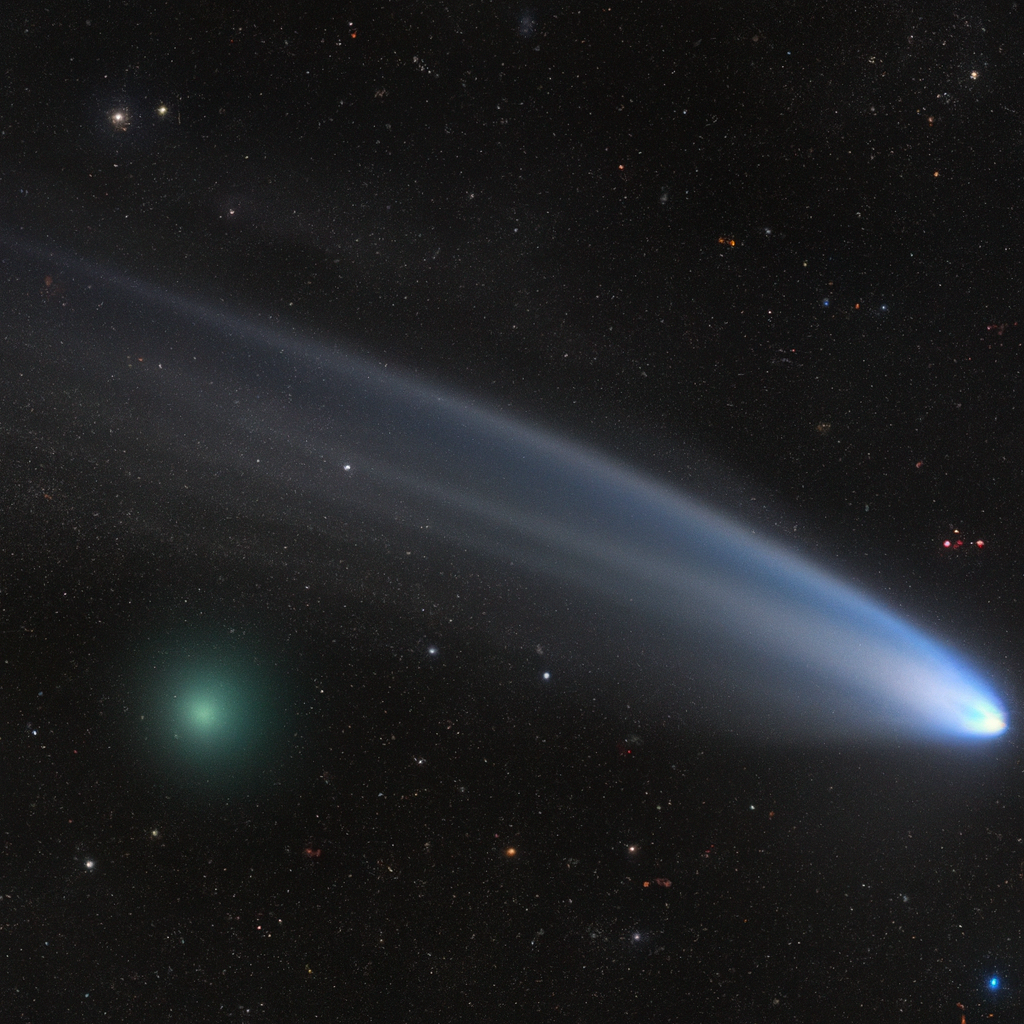
The interstellar comet 3I/ATLAS is garnering significant attention as it approaches Earth, with its unique characteristics providing valuable insights into the nature of such celestial bodies. According to astronomer Avi Loeb, the anti-tail of 3I/ATLAS is reported to be larger than the distance to the Moon, a remarkable feature that highlights the comet’s vast dimensions and its potential for scientific study. This close approach offers astronomers a rare opportunity to observe an interstellar object, a category that has only recently been recognized since the first confirmed interstellar comet, ‘Oumuamua’, passed through our solar system in 2017.
The importance of 3I/ATLAS’s approach is underscored by the involvement of the UN’s International Asteroid Warning Network, which has been closely monitoring the comet. The organization’s attention indicates the comet’s potential implications not just for scientific research but also for planetary defense strategies. In a statement, the network emphasized the significance of tracking such objects to understand their trajectories and potential risks they might pose to Earth.
In addition to its size, the comet’s distinctive greenish glow, captured in recent images by the Gemini North telescope, has sparked interest among both professional astronomers and the public. Such observations contribute to ongoing discussions about the composition and behavior of comets, particularly those originating from outside our solar system. Historically, interstellar comets have been rare, making this event notable for both its frequency and the scientific questions it raises regarding the origins of these celestial bodies.
The implications of studying 3I/ATLAS extend beyond astronomy; they touch on broader themes of space exploration and international collaboration in monitoring and understanding extraterrestrial phenomena. As the scientific community continues to analyze data from 3I/ATLAS, comparisons with previous interstellar objects will likely lead to deeper insights into the dynamics of our universe. The excitement surrounding this comet is reminiscent of the public interest generated during previous astronomical events, such as the passing of the comet Hale-Bopp in the late 1990s, which captivated skywatchers worldwide.
As we approach the point of closest approach, the scientific community remains optimistic about the data that will be collected, which may inform future studies of interstellar objects. The opportunity presented by 3I/ATLAS reinforces the importance of continued investment in astronomical research and planetary defense initiatives, as humanity seeks to better understand its place in the cosmos.